


Spy Hop, a creative youth development organization based in Utah, has spent more than 25 years creating a space where young people find their voice, build community, and share meaningful creative work with real-world audiences. Alumni, mentors, and staff all understood the impact was real.
What was less clear, but far more difficult, was how to study that impact over time. Spy Hop wanted to test and deepen its logic model by asking a fundamental question: what becomes of participants as they move into adulthood, and what kinds of longer-term outcomes emerge in their lives and communities?
They were particularly interested in understanding impact beyond immediate program experiences—how participation might influence trajectories in the workforce, civic life, community engagement, and the broader cultural landscape.
Spy Hop wasn’t interested in an evaluation designed to simply validate what they already believed. They were seeking something more expansive: an honest appraisal and a deeper understanding of their long-term impact—not just what alumni achieved, but who they became over time. They needed an approach that could be rigorous enough to stand up in the broader field, while still honoring the relational, creative, and human nature of the work.
They asked Convergence Design Lab to design a study that could hold that complexity.
From the beginning, we were intentional about not starting with predetermined conclusions. Instead, we designed a study that allowed patterns to emerge—grounded in research, but led by alumni voice.
We began by looking outward. A literature review across creative youth development, learning sciences, and media education helped us understand how the field has approached long-term outcomes, and where gaps remain. This informed the development of an outcomes framework that grounded the study in existing research while leaving room for new insights to surface.
From there, we turned to alumni. Before finalizing the survey, we gathered their perspectives on what mattered—what stayed with them, what shaped their lives, and what questions felt worth asking. This ensured the instrument reflected lived experience, not just standard evaluation categories.
We then worked closely with Spy Hop leadership and teaching artists to deepen the design. Their insights helped us understand the internal logic of the program—what happens inside the experience that might lead to lasting change—and pushed the study beyond traditional endpoints like career or education toward transformation: shifts in identity, agency, and voice.
The final study combined multiple forms of data. Seventy-five alumni completed the survey, spanning cohorts from the late 1990s through recent years, including many who were 10, 15, and even 20 years removed from the program. To deepen and contextualize those findings, we conducted interviews and focus groups with more than 30 participants, alongside a review of historical evaluation data alongside a review of historical evaluation data. Our goal was to create a rich, longitudinal picture of enduring impact.
What distinguished the process was how we worked with the qualitative data. We made space for open-ended responses and returned to them in multiple rounds of coding, allowing meaning to build over time rather than forcing early conclusions.
Out of this synthesis emerged a clear developmental pattern—the Ripple Effect—where early experiences of voice and belonging extend outward into work, community, and cultural life.
Several insights shifted our understanding of impact.
One of the most surprising discoveries was that transformation did not depend on long-term participation. While we expected “dosage” to matter, alumni consistently described single experiences—a class, a project, a moment of being taken seriously—as pivotal. The intensity and meaning of the experience mattered as much as its duration.

We also found that the most lasting outcomes were not technical skills, but changes in how alumni saw themselves. Many described Spy Hop as the first place they experienced themselves as capable contributors, and that sense of agency carried forward into adulthood. As one alum put it, the experience became “an identifying piece of my DNA.”
Across the data, three patterns emerged that define the long-term impact of the work.
Alumni become adaptive innovators—people who carry creativity, problem-solving, and confidence into a wide range of careers.
They become civic multipliers—individuals who engage in their communities with a strong sense of voice, responsibility, and connection to others.
And they become cultural catalysts—people who continue to create, support, and shape the cultural life around them, whether or not they work professionally in the arts.
What connects these outcomes is not a single pathway, but a shared developmental foundation rooted in creative community, positive identity development, and meaningful contribution.
Results
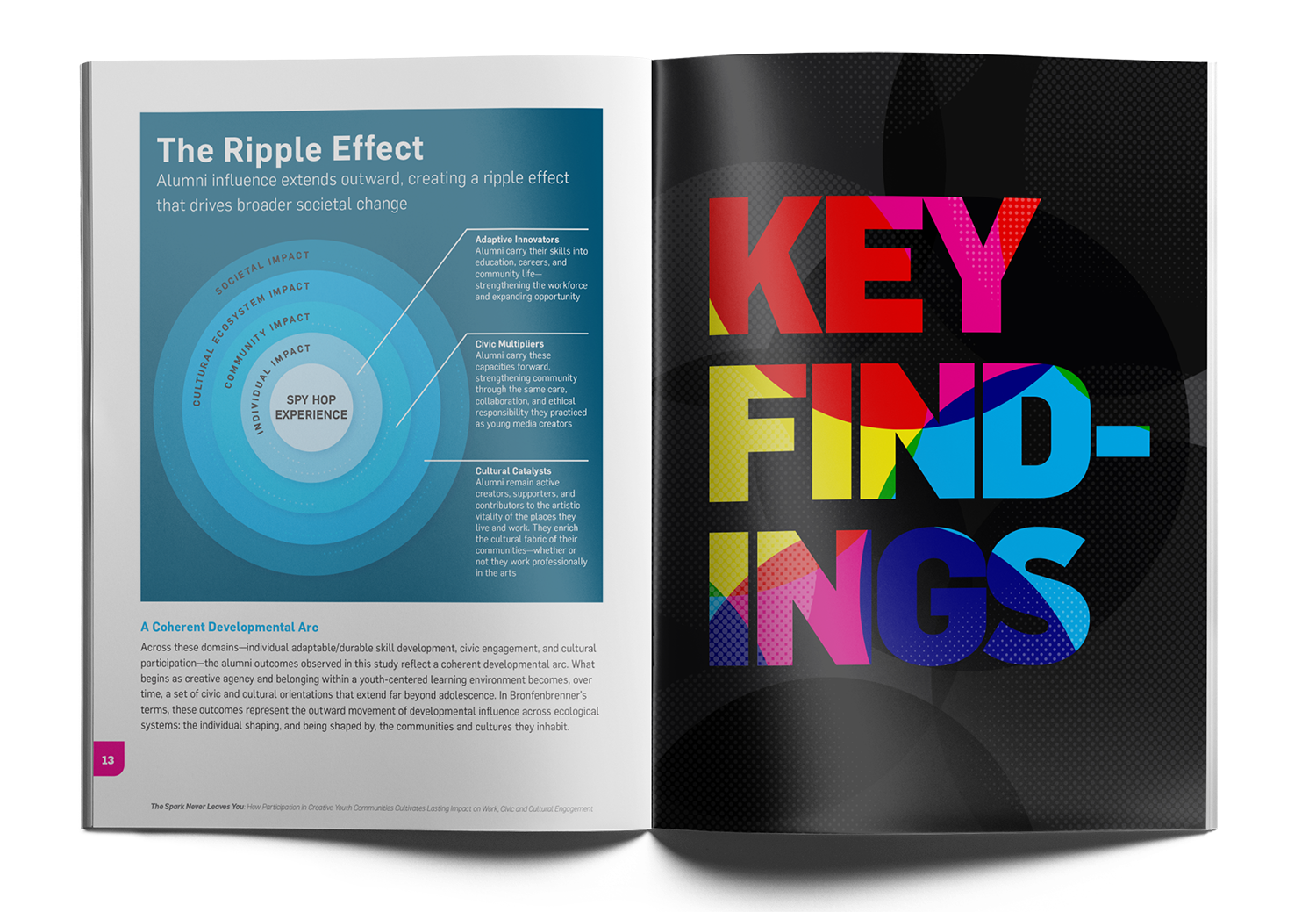
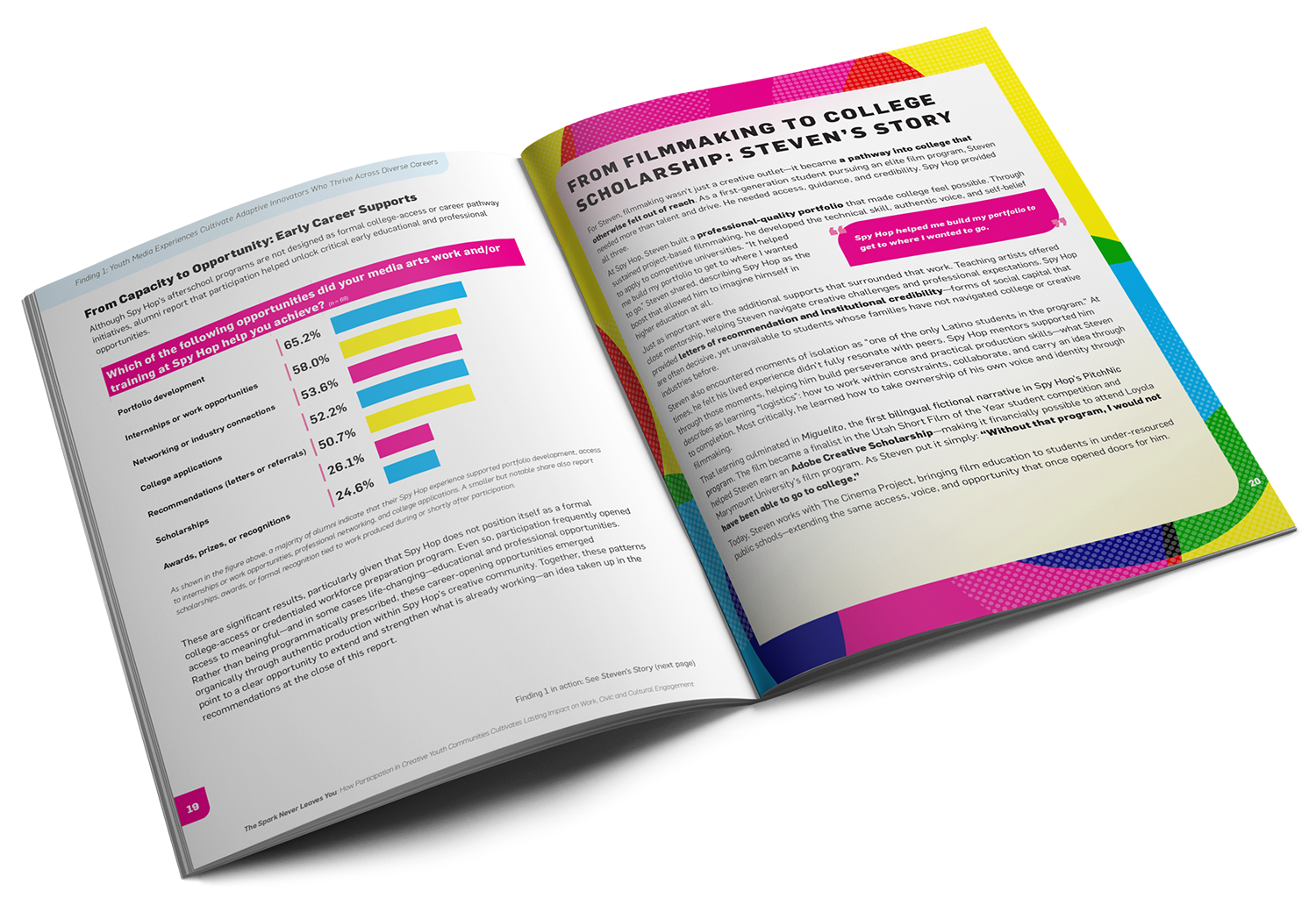
The study resulted in The Spark Never Leaves You, a comprehensive alumni report that weaves together research, narrative, and visual storytelling. It includes key findings from a mixed-methods analysis of alumni experiences, along with the Ripple Effect model, which traces how individual transformation extends into broader societal impact. A set of recommendations and a presentation slide deck equip Spy Hop with tools for both internal reflection and external storytelling with funders and stakeholders.
Convergence also led the design of the publication in collaboration with Kate Burgener Creative, applying Spy Hop’s visual identity to create a report that is both engaging and accessible, while maintaining the rigor of a scholarly publication.
Importantly, the process brought new clarity to how Spy Hop understands and articulates its impact. The study captures not only proximal outcomes for participants, but a broader societal return on that investment—giving language and evidence to something long understood: that the impact of this work extends beyond programs and continues to unfold across people’s lives and communities.
More broadly, the study models a different approach to understanding impact—one that is iterative, participatory, and transparent—strengthening not only the evidence base for Spy Hop’s work, but the trust and accountability that underpin it.

Our flexible and client-centered approach ensures that the final outcome is perfectly tailored to meet your organization’s unique vision of success.

